Gunner JKU
Trial and error build-on-a-budget of our JKU Sport.
Our goal: be able to run all the
Jeep Badge of Honor Trails.
Starting with the easiest and culminating
with Rubicon Trail;
while maintaining nice driving characteristics and
using it as a Daily Driver.
Most importantly, we need to do this on a
budget!
You can follow our Journey on YOUTUBE
Check out our CO2 system on Instagram
@OffroadAirBuddy
More information on how to air up your tires FAST at Offroadairbuddy.com
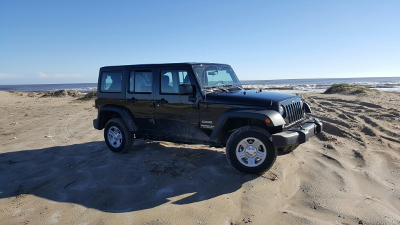
We started in 2018 with a 2017 Jeep Wrangler 4-door Sport,
JKU. The mall-crawler of the Wrangler Family.
Here are some things I didn't know:
- Out of the 3 models of Wrangler (Sport, Sahara, Rubicon) the Rubicon is
has more offroad specific features
- 4 wheel drive doesn't involve putting power to all 4
wheels!!! (only 2 wheels at best)
- You can't just put bigger tires on a Jeep
- You can't just put bigger/heavier/longer springs and shocks
on a jeep to lift it.. (not if you want it to still perform well)
- Weight matters. All the aftermarket crap you get to add to
your Jeep makes it work harder and more likely to get stuck
So we bought our 2017 JKU Sport and started a learning process.
Before
we get into anything here, let's talk about what it means to build a
Jeep up on a budget. A budget can mean different things to different
people. For us, the budget for our build was totally non-existent. I
had a 4runner that I was happy with and planned to keep 5 more years.
But it was totalled and I only received around $4,000 for my 12 yr old
4runner! We put $1k down on the Jeep. We decided to send $1k to our
beloved Treasury Department to get all caught up. So other than our
initial remaining $2K from insurance, we only had whatever we could
save up each week. If I take my lunch to work I can usually put
$20/week aside. Sometimes $30. So, that's our budget.
First
thing I wanted to do was lift the Jeep and put bigger tires on it. I
think that's true for most people. Turns out, it's not that easy! If
you lift more than 2.5" (give or take) then you change the orientation
of your axle under your vehicle, and you change the angle at which your
driveshaft connects to your axles. The driveshaft has a little
play/adjustability, but beyond 2.5" or so you start to need a new
driveshaft, control arms, and you might start to need to do something
to bring your trackbar and drag link back into a more parallel setup.
Plus, of course, the taller you go, the more wind you catch, lower
mpg's and higher center of gravity, unless you do a few things to lower
your center of gravity... more on that later. Plus, it also costs
more.. So, not being a millionaire I had to decide how tall I wanted
go, but balance that against costs and how many extra expensive costs
taller would require. I wanted to go tall enough to run some good
trails. Of course, you can run a lot of hard trails totally stock, but
getting a lift makes it that much easier, and less likely to damage you.
The
tires are a whole nother issue. The bigger tires are
heavier, and rotating weight has more inertia than static weight, just
sitting on the vehicle. Therefore, add 5 lb heavier tires is like
adding 20 lbs of static cargo. And if each tire is 5 lbs heavier that
would be like adding 80 lbs of payload. Now, if your new rims are
heavier, to support those bigger tires, then add that weight too.
But it's worse than that! Your bigger tire has a larger diameter,
and that larger diameter creates even more inertia. All
your suspension and steering components will be under more stress than
they were designed to handle. To go really big (40" or more) you
definitely need different axles, ball joints, u joints, driveshafts,
control arms, etc. After learning this, people usually ask,
"well how much bigger can I go with my stock components without causing damage?" But that's a
hard question to answer. It kinda depends on how you drive, whether you
offroad, and how hardcore you are about it. But a general rule of thumb
is going offroad will wear stuff out. Going offroad with bigger tires
will wear stuff out quicker, the bigger the tires. The harder the trail
and the harder you go, the quicker you'll break things. So, some people
will put 35" tires on their Sport Wrangler with it's weak-ass Dana30
front axle and be just fine for years! Other people, like me, will try
to be cautious and put only 33" tires (that are light for their size)
on a set of lightweight rims, and still break their axle housing in the
first few months of ownership!
I
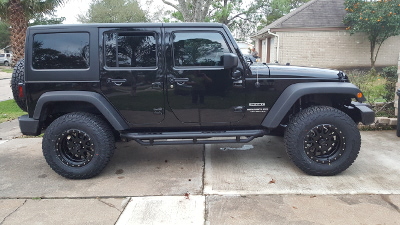
started with a Teraflex 2.5" lift with shocks and springs.
Smittybilt Rocksliders, and 33" tires. That sounds like a like, but
lift was only $750, the Falken wildpeak tires were $150/ea, and the
Pro-comp rims were bought used for $30/each. The rocksliders were $300,
and they were a mistake, but I'll get to that. I had someone do the
lift, because I "wanted it done right" and I had never done one. That
was also a mistake, I ended up having to re-do it myself, and correct
issues (such as rubbing brake lines, and backwards bump-stops). I
should have just done it myself in the first place. lesson learned.
Everything else I have done myself, with the execption of welding and
gears. I picked the wrong rocksliders. My thinking was that they would
provide protection to the undercarriage since I didn't have any extra
skid plates, other than what came on the Jeep. But what I didn't
realize is that the third bar on the rockslicder hangs down and limits
my clearance, including my break-over angle. I could gain an inch or
more with a different style of sliders. This ate up my whole budget.
Every penny. I used a credit card to get my windows professionally
tinted, and it would take me months to pay that off.
This setup was good for a while. I lost some power/torque
because of the larger tires, and my speedo wasn't accurate. I had to
spend $200 on a programmer that could reset my tire size and re-program
my automatic transmission shift points. I ended up getting a Superchips 3571 Flashcal F5 Tuner from Amazon. It works pretty well. I definitely got some ZIP back in the Jeep!
 Superchips Flashcal F5. Help you re-program your tire size, which
effects your speedo and shift-points with an auto transmission.
Superchips Flashcal F5. Help you re-program your tire size, which
effects your speedo and shift-points with an auto transmission.
This
was fine for a year or more. I could keep up with other jeeps on the
easier trails. I could cross 36" of water (after extending my breather
tubes). Extending your breather tubes, by the way, is easy and
cheap!! Cost me all of $0.00 because we had some extra tubing at
work, but you can buy the tubing for less than $20 or $30 I feel
sure. Extending the breathing tubes helps keep water out of the
diffs and Xfer case just in case of deeper water crossings. The
jeep floated across sand on the beach, and crawled up steep rocky
inclines. It didn't handle mud that great, but I try to avoid mud
whenever possible anyway. The Falken Wildpeak AT3W's aren't really
awesome mud tires, they don't "clean" or fling mud out very great.
I don't have a picture to show, but I broke my axle housing
out on the mud flats past san luis pass on the Texas coast. My wife and
I were bombing along and I made a mistake. I was headed toward a water
puddle that I thought we had driven through slowly earlier.. but as I
was almost on top of it, I realized that it was a different water
puddle, and I didn't know how deep it was. It was too late to slow
down, and there was a huge hidden hole in this puddle. The jeep hit at
maybe 15 mph with a bang! The camera we were filming with went flying,
and then we were through and kept going. Everything seemed okay at
first, but then I realized the steering wheel was at 90 degrees where
it should be!! We limped back to the road and I slid under the jeep to
adjust the steering wheel position. As the next few months went by we
noticed the differential sagging lower and the tires splayed outwards,
because the axle housing was slowly breaking/bending!! Jeep replaced it under factory warranty... no questions asked!!
The way you find out what you need is to get out there and run
some trails, and when you can't do something, you can modify your Jeep
to accomplish whatever it is. The first thing that happened to me is
that on my buddy's property, I was driving through some low brush, and
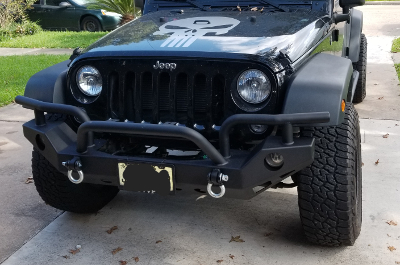
my front bumper started getting deep scrapes and gouges. When it got a
few dents on another trip I decided I needed a steel bumper. I knew I
wanted better tire clearance, as I would be going up to 35" tires
eventually. I knew I would eventually want a winch. So I picked a
bumper that looked like it provided good full-width protection and had
a winch plate. What I didn't realize is how much the front end of the
Jeep would sag from the combined weight of this bumper plus winch.
Bumper was $400 ish.
Now equipped to handle low brush I headed back out to some
trails only to get stuck in the mud. Not even deep mud. Not even a wide
patch of mud. Just a muddy rut that a guy on a dirt bike had driven
through right ahead of me!!
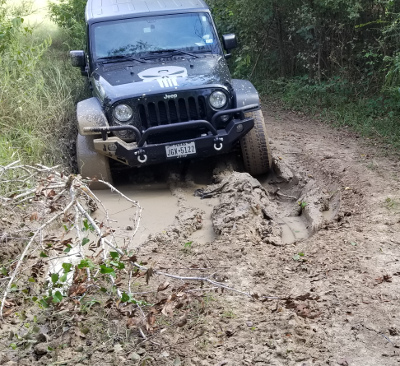
I tried going forward and reverse. I tried 4 low, 4 high. I
tried putting rocks and sticks down. You can't really tell from the
photo, but the jeep's in a shallow valley, it's uphill in front and
behind it. 2 of my tires (1 front and 1 rear) spun and spun.. Because
in 4 wheel drive, you only have power to 2 tires. Which front one has
the LEAST amount of traction, and whichever rear one has the LEAST
amount of traction. it's not awesome. I didn't have a winch, so I had
to call someone for help, and get pulled outta this hole. I started
saving up for a winch right away.
Went to a local 4x4 park called Hidden Falls, and had a lot of
fun sitting in the mud to disconnect my sway bars, and then again after
the day was done, trying to get them re-connected. I decided that some
kind of quick disconnect system was in my near future. Rubicons come
with an electronic disconnect that works well for a while (inside joke).
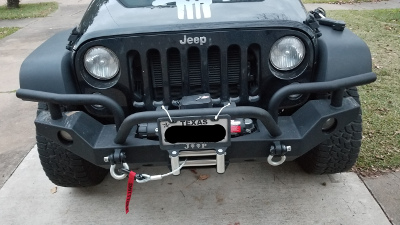
Saved
up for a couple of months and picked up a Smitttybilt
XRC 9500 lb winch for under $300. I knew I also wanted lockers, but I
also knew I couldn't afford lockers anytime soon. In the meantime, a
winch gave me the possiblity of pulling myself out, if there was
anything nearby to anchor onto. I also slowly built up a recovery bag
that included rope, straps, shackles, snatch blocks, shovel,
etc. I wanted a stronger 12,000 lb winch, and wanted
synthetic rope, but those were significantly more expensive than the
winch I got.
I'd call the Jeep pretty effective at this point. But I
still
wanted more. I didn't want to have to winch out of the mud.
I wanted to be able to go through the mud when I couldn't go around
it. That means I needed mud tires and lockers. If I was
going to buy mud
tires, I might as well go ahead and get 35's too, but I had three
problems. 1. Money, and 2. the fact that my front axle was weak and I
knew it firsthand. I discovered that if I put bigger heavier tires on,
I'd be likely to wear out my u-joints, ball-joints, and other steering
components even quicker. Any kind of impact offroading would be
magnified due to the heavier tires. Also my auto transmission was
geared to 3.21 and was already having a little trouble with my 33"
tires. And 3. I couldn't carry a heavy 35" tire on my tailgate, it just
wasn't made for that, I'd have to get a tire carrier.
In the meantime, we continued enjoying the crap out of the
Jeep, traveling through Big Bend National Park, and having all kinds of
adventures.. learning to work on vehicles..:
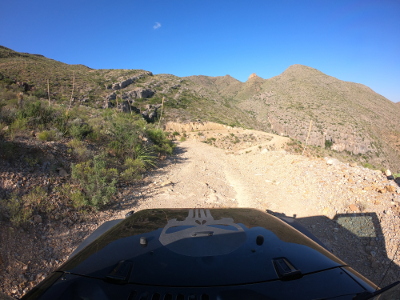
driving up the mountains |
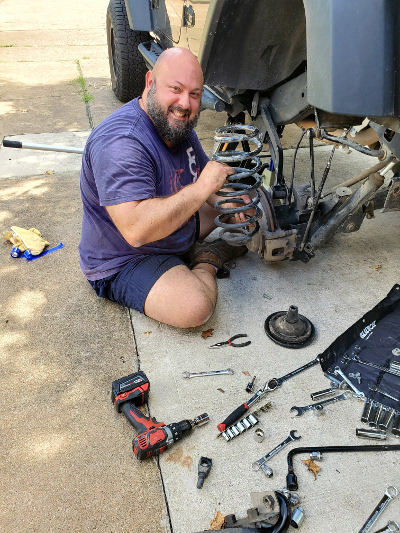
learning how to install a lift. (yeah, I can't compress the spring with
my hands) |
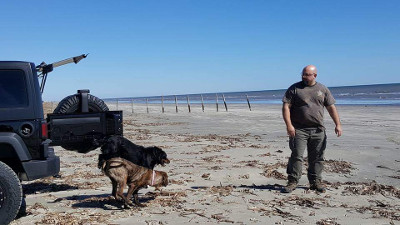
taking the dogs to the beach |
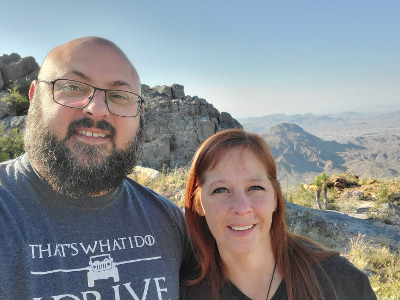
It brought us together and allowed us to do interesting things that we
would never do otherwise. |
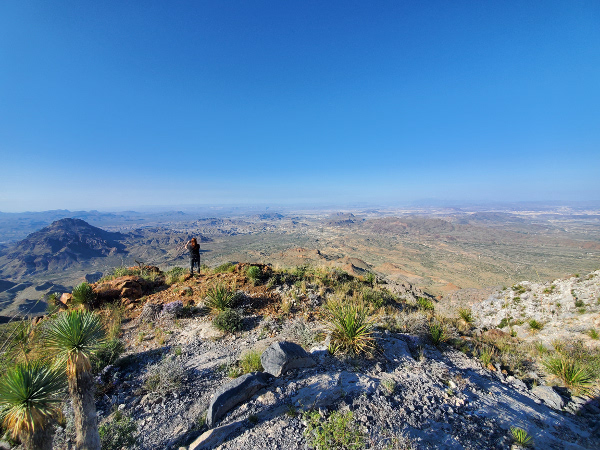
Watching my wife enjoy looking down on mountaintops.. |
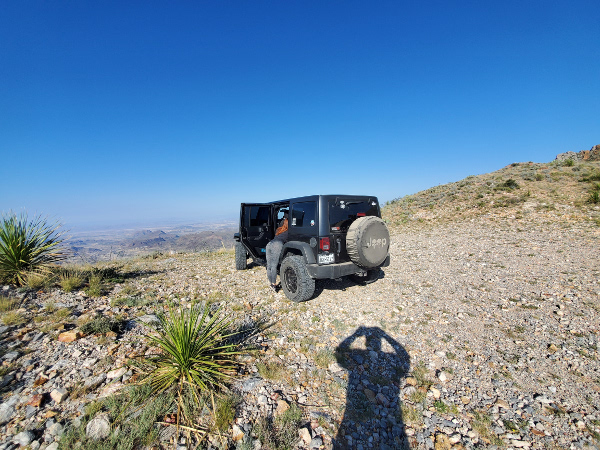
I was also enjoying the view! |
While we had fun enjoying the Jeep, I saved and scrimped and
planned and schemed, researching, and hunting for good deals. I knew
that it wasn't ready for really serious trails just yet. We were able
to get our first Badge of Honor from Black Gap, which Chrisy drove by
herself!
While in Big Bend we ended up on a 6 hour trail (River Road
West), there was no cell service and I started thinking that if we
broke down, it might be days before someone else decided to travel down
that particular infrequently traveled trail. I started thinking about
communications and what sort of radio would be good to keep in the
Jeep. After monhs of research I settled on HAM radio being the best to
use in case of emergency to call for help. Communicating with other
jeepers would probably be CB or GMRS. See the comms page for more on that subject.
Also, it was starting to get dark. So if it had ended up
taking us a couple of more hours than it did, we would have been
driving through a barely discernible trail in the dark of night. When
we got back home from this trip I added trail lights to the front ($15) and
added reverse trail lights to my rear bumper requirements.
The
solution was to buy a tire carrier, re-gear, truss and
gusset and sleeve my axle, and while the gears were getting installed,
go ahead and get at least a rear locker. Then I could run my 35" tires
and probably just have to replace the ball joints and u-joints, but at
least my axle should be okay. Since I found relatively cheap tires
(Milestars) all of that together was somewhere in the neighborhood of
$5000.00 including a rear bumper that wasn't necessary, strictly
speaking, but looks good with the rest of the stuff. That would take me
several years to save up, and likely get spent on other things before I
ever reached that figure. I ended up having to sell some toys from
another hobby. I won't go into that here, but sacrifices had to be
made, various gods appeased, etc. Also a new feature on
Northridge 4x4 and Extreme Terrain called "Affirm" allowed me to buy
some parts on credit and pay them off over a year.
With the new 35" Milestar Patagonia tires on, I found that I
didn't have enough clearance when offroading. My tire was getting
jammed up into my fender. I cost me nothing to cut my fenders to make
them flat. And I added a 1/2" lift all around to help combat the sag
from the front and rear bumpers.
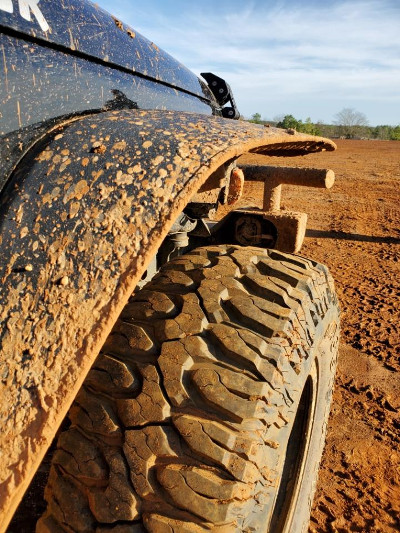
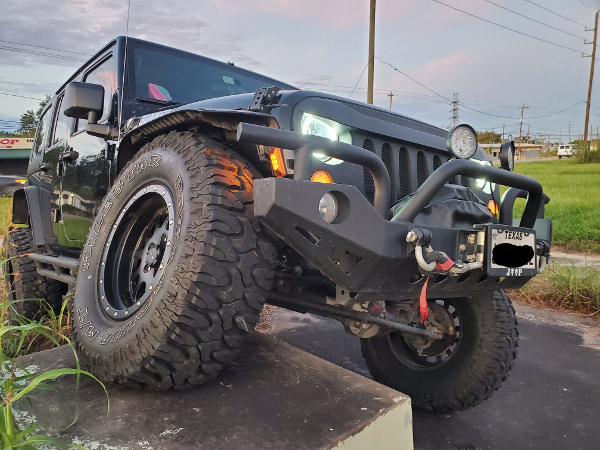
Now we're talking.. got about 1/2" fender clearance... not quite max
flex though..
As of today the build entails:
Teraflex lift
Rough country adjustable trackbar
Z36 Extreme HD brakes
Pro comp Rims
Milestar Patagonia 35" MT
Wild Hog front bumper with trail lights
Smittybilt SRC Gen 2 rear bumper with reverse led's
Smittybilt 9500 Xrc Winch waterproof
Smittybilt rock sliders
RedRock 4x4 heavy duty Tire Carrier
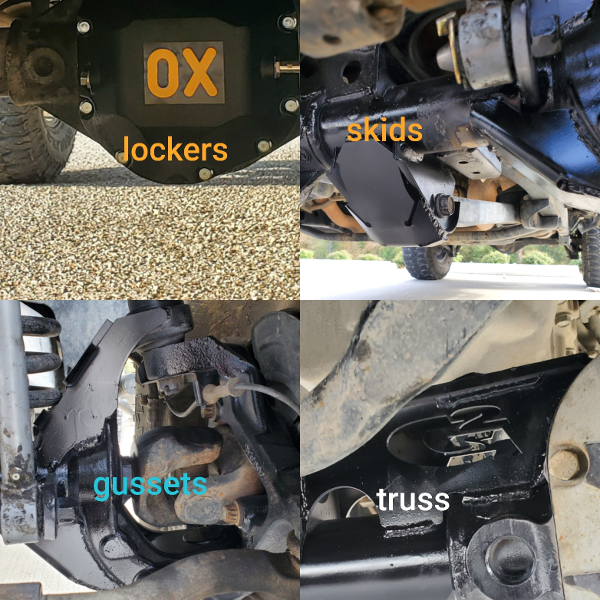
G2 D30 Truss, gussets, and sleeves
G2 4.56 Gears
Ox Locker (cable type) rear
Poison Spyder front D30 differential cover
front lower control arm skid plates
Wild Hog grab bars, Interior LED lights
Offroad Air Buddy CO2 system to air up my tires FAST
If I had it to do over, I would have done a 3" lift from the beginning,
minimum. If I had the money I would do 4".
I would
select aluminum bumpers whereever possible, or at least stubby bumpers to
save on weight. I would use
synthetic rope, to further save on weight.
I wouldn't have purchased a rear diff cover, I would have just waited
until I got my rear locker, since one comes with the locker. Or better
yet, I could skip the front diff cover and just
go with a skid plate
for the front. Probably better protection in the long run.
Eventually, and probably sooner than later I'll need to
replace my ball joints, U-joints, and possibly consider a big brake
kit. When going down a steep hill, on a shelf drop-off, my
brakes aren't quite holding as tight as I'd like. That's the kind of
situation where you want to EASE down oh so slowly so as to not damage
steering components. My drag link is currently bent, as I
type this, from one wheeling trip or another, but I just drove to AZ
and back with it, and it did fine, so until it bends more it's not a
huge priority. When I do replace it eventually, I'll look into
"flipping" it for extra clearance. You can check out our trip to
Schnebly hill Rd on Youtube!
|